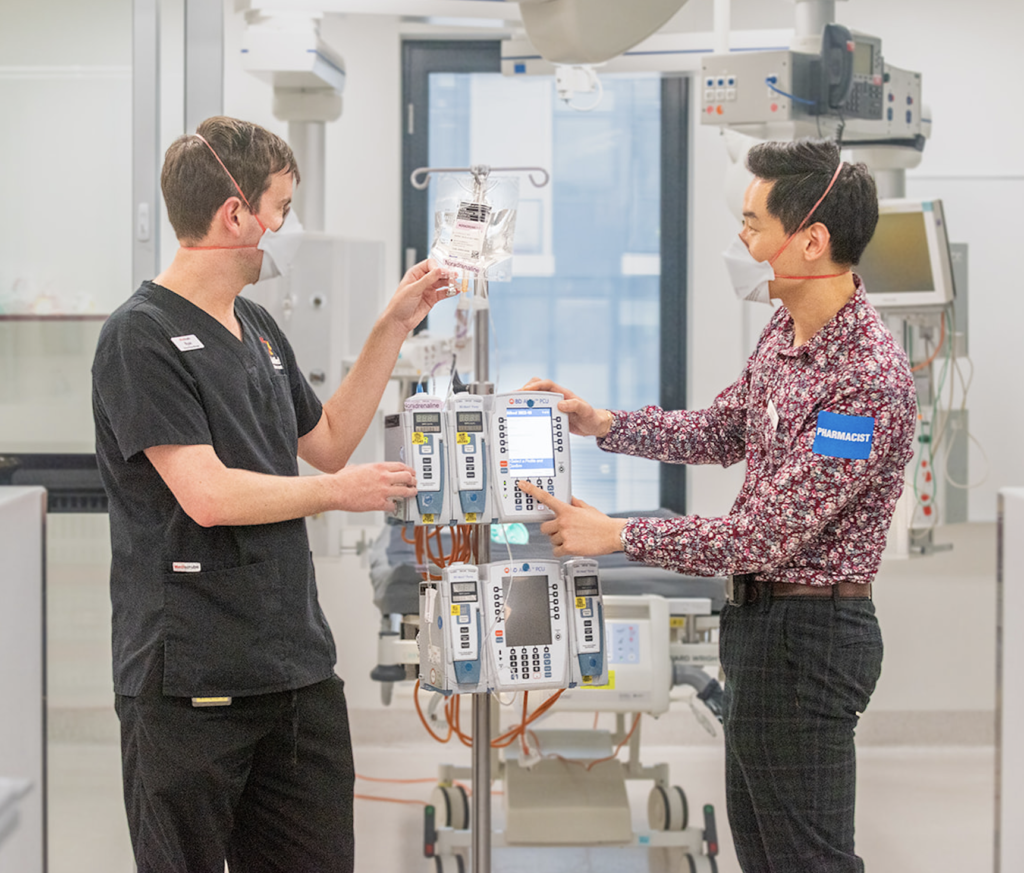
Learn from leading pharmacists in Emergency Medicine to fast-track your skills in upfront clinical decision making in the management of critically ill and injured patients
Alfred Health’s team of specialised Emergency Medicine (EM) pharmacists are practicing at the forefront of their field, establishing numerous evidence-based extended scope practice roles for clinical pharmacists. Each Alfred Health EM pharmacist has completed credentialing to provide them with expertise to respond to stroke calls, sepsis calls and trauma calls.
The Emergency Medicine Pharmacy Practice Placement provides learners with the opportunity to work closely with Senior and Lead EM Pharmacists to transfer their EM knowledge to real-life clinical practice and become credentialed* to be able to participate in stroke and sepsis calls in accordance with their local Emergency Department’s policies and governance.
Extended scope credentials in the ED can improve patient care:
- EM pharmacist involvement in Australian stroke callout teams reduced median thrombolysis door to needle time by 12 minutes.1
- Introduction of EM pharmacists into sepsis alerts improved the proportion of patients receiving antibiotics within 60 minutes for patients requiring transfer to the Intensive Care Unit.2
This extension course has been designed by an expert team of EM pharmacists and EM physicians to apply knowledge and core skills developed through the Fundamentals of Contemporary Emergency Medicine Pharmacy course. Pharmacists will also gain exposure to other critically ill patient scenarios such as ST-elevation myocardial infarction (STEMI) calls and trauma calls with opportunity to build confidence in closed loop multi-disciplinary communication and up-front decision making through online learning and placement.
Prerequisites:
- Registered pharmacist
- Successful completion of Option 2 or 3 of Alfred Health’s Fundamentals of Contemporary Emergency Medicine Pharmacy course
- Minimum of 2-years clinical pharmacy experience in acute care (preferably in Critical Care [e.g., Emergency Medicine, Intensive Care] and/or General Medicine).
Pharmacists with existing clinical experience in Emergency Medicine (ie, 6-12 months) are likely to be better equipped to succeed in meeting the level of clinical competency required to become credentialed in sepsis and stroke calls. However, EM experience is not an absolute prerequisite, and we encourage interested parties to discuss their suitability for registration with our Pharmacy Learning and Development Hub team (pharmhub@alfred.org.au)
Core Modules:
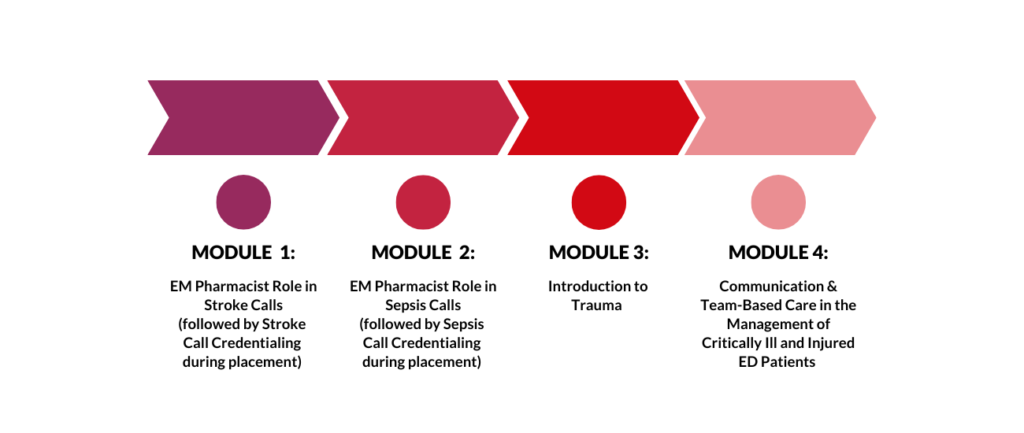
The online component of this course is comprised of four e-Learning modules:
Experiential Placement:
- 4 day (8-hours per day) one-on-one practice-based experiential placement in our E&TC supervised by specialised Lead or Senior EM pharmacists. Learners will apply their new knowledge and skills to real-life clinical practice and develop skills in upfront clinical decision-making in the management of critically ill and injured ED patients.
- During this placement, pharmacists will be observed, mentored, and formally assessed through an Objective Structured Clinical Examination (OSCE) by Lead or Senior EM pharmacists, and EM physicians or Stroke consultants, for credentialing in stroke and sepsis calls.* Pharmacists will also be exposed to various other acute resuscitation scenarios during placement, with potential for upskilling in the management of other critically ill and injured ED patient scenarios.

The e-Learning module in this course may be included as 7 hours of CPD upon successful completion of its integrated assessment activities. The placement in this course may be included as 32 hours of CPD upon successful completion of its integrated assessment activities.
The 2016 Competency Standards that align with this course include:
- 1.1 Uphold professionalism in practice
- 1.2 Observe and promote ethical standards
- 1.3 Practise within appliable legal framework
- 1.5 Apply expertise in professional practice
- 1.6 Contribute to continuous improvement in quality and safety
- 2.2 Collaborate with professional colleagues
- 2.3 Communicate effectively
- 2.4 Apply interpersonal communication skills to address problems
- 3.1 Develop a patient centred, culturally responsive approach to medication management
- 3.2 Implement the medication management strategy or plan
- 3.3 Monitor and evaluate medication management
- 3.5 Support Quality Use of Medicines
- 4.3 Show leadership in practice
On completion of the online e-Learning modules and Experiential Placement, participants should be able to:
- Demonstrate the ability to competently and independently participate in Sepsis Calls, contributing to upfront clinical decision-making regarding empiric antimicrobial selection, dosing, prescribing and administration.**
- Demonstrate the ability to competently and independently participate in Stroke Calls, contributing to upfront clinical decision-making regarding hyperacute blood pressure management, and thrombolysis dosing, prescribing and administration. **
- Explain the general principles of assessment, management of trauma call patients in the E&TC.
- Discuss the principles of closed-loop communication and the team-based approach to the reception and resuscitation of critically ill and injured ED patients.
- Each online module will be consolidated via a multiple-choice assessment based on real-life cases.
- Participants will be observed and assessed by Lead or Senior EM pharmacists, and EM physicians or Stroke consultants, to become credentialed in stroke and sepsis calls.
Credentialing will not be obtained by placement attendance alone – to become credentialed, pharmacists must meet the minimal level of competency by successfully passing relevant assessments to safely and independently participate in stroke and sepsis calls.
Participants will be awarded an overall course certificate of completion, as well as individual credentialing certificates for stroke and sepsis calls upon satisfactory completion of the required learning and assessments.
Registrations now available
Registration includes 12 months of access to the e-Learning modules from the date of registration.
*Course Prerequisite: Completion of Option 2 or 3 of Alfred Health’s Fundamentals of Contemporary Emergency Medicine Pharmacy course
e-Learning & Experiential Placement
-
Prices include GST
-
Includes 7 hours of self-directed e-Learning modules on extended scope EM clinical pharmacist practices AND
-
4-day experiential placement in The Alfred E&TC with one-on-one supervision by a Lead or Senior EM pharmacist
Course Bundle Offer
Emergency Medicine Pharmacy Course Bundle Offer
-
Prices include GST
-
Receive a $350 discount if you register for both of the following courses:
Fundamentals of Contemporary Emergency Medicine Pharmacy course (Option 3)
AND
Emergency Medicine Pharmacy Practice Placement course
Express your interest in this program
Not ready to start the program right now? Have more questions?
Enter your details below to express your interest or ask us a question about this program and our Pharmacy Learning and Development team will be in touch.
Disclaimers: *Credentialing will not be obtained by placement attendance alone – to become credentialed, pharmacists must meet the minimal level of competency by successfully passing relevant assessments to safely and independently partake in stroke and sepsis calls. **Pharmacists who become credentialed in stroke and sepsis calls on completion of the Emergency Medicine Pharmacy Practice Placement must only participate in these activities if this scope of practice is supported by the healthcare organisation(s) with whom the pharmacist is employed. Where this scope of practice is supported, participation in stroke and sepsis calls should occur in a manner consistent with the local policies and governance of relevant healthcare organisation(s). The Fundamentals of Contemporary Emergency Medicine Pharmacy course and the Emergency Medicine Pharmacy Practice Placement do not provide Partnered Pharmacist Medication Charting (PPMC) credentialing, however, if you are already PPMC credentialed and PPMC is a supported model of care within your local healthcare organisation(s), this course will upskill you in charting for critically ill ED patients. While every effort will be made to ensure pharmacists participating in the Emergency Medicine Pharmacy Practice Placement are exposed to a minimum of one real-life stroke call and one real-life sepsis call, we cannot guarantee that these calls will occur/present during every placement. Furthermore, we cannot guarantee that all pharmacists will be exposed to real-life IV thrombolysis during their placement as IV thrombolysis will not be appropriate in all stroke calls. Where exposure to real-life cases is not possible or feasible, simulated cases will be utilised to meet credentialing requirements for this placement. |
References:
- Roman C, Cloud G, Dooley M, Mitra B. Involvement of emergency medicine pharmacists in stroke thrombolysis: A cohort study. Journal of Clinical Pharmacy and Therapeutics. 2021 Aug;46(4):1095-102.
- Roman CP, Dooley M, Nevill A, Szmidel M, McGloughlin S, Luckhoff C, Mitra B. Introduction of an emergency medicine pharmacist‐led sepsis alert response system in the emergency department: A cohort study. Emergency Medicine Australasia. 2023 Jan 12.